Who it is for · ·
Archive a source before it is changed
To archive a source, Clean Web Clipper holds a page’s full text, its source URL and the publication date it declared, in a plain file you keep yourself. Pages are edited and taken down without notice; the file is not in a service that can close, change its terms or lose the record.
Where these numbers come from: the benchmark, with engine versions and dates
What happens to the page that was there yesterday?
A company posts a claim, you cite it, and by the time an editor reads the draft the sentence has been quietly reworded – no correction note, no timestamp, nothing to point at. Or the page has gone entirely, and the public archives never caught it because it lived for four hours on a Sunday afternoon.
Even when a page survives, the version you read may not be the version anyone else was served. Consent walls, regional variants and A/B tests mean a URL is not a stable reference to a text. What you can hold onto is what was on your screen when you read it, saved with the address and the date the page declared for itself.
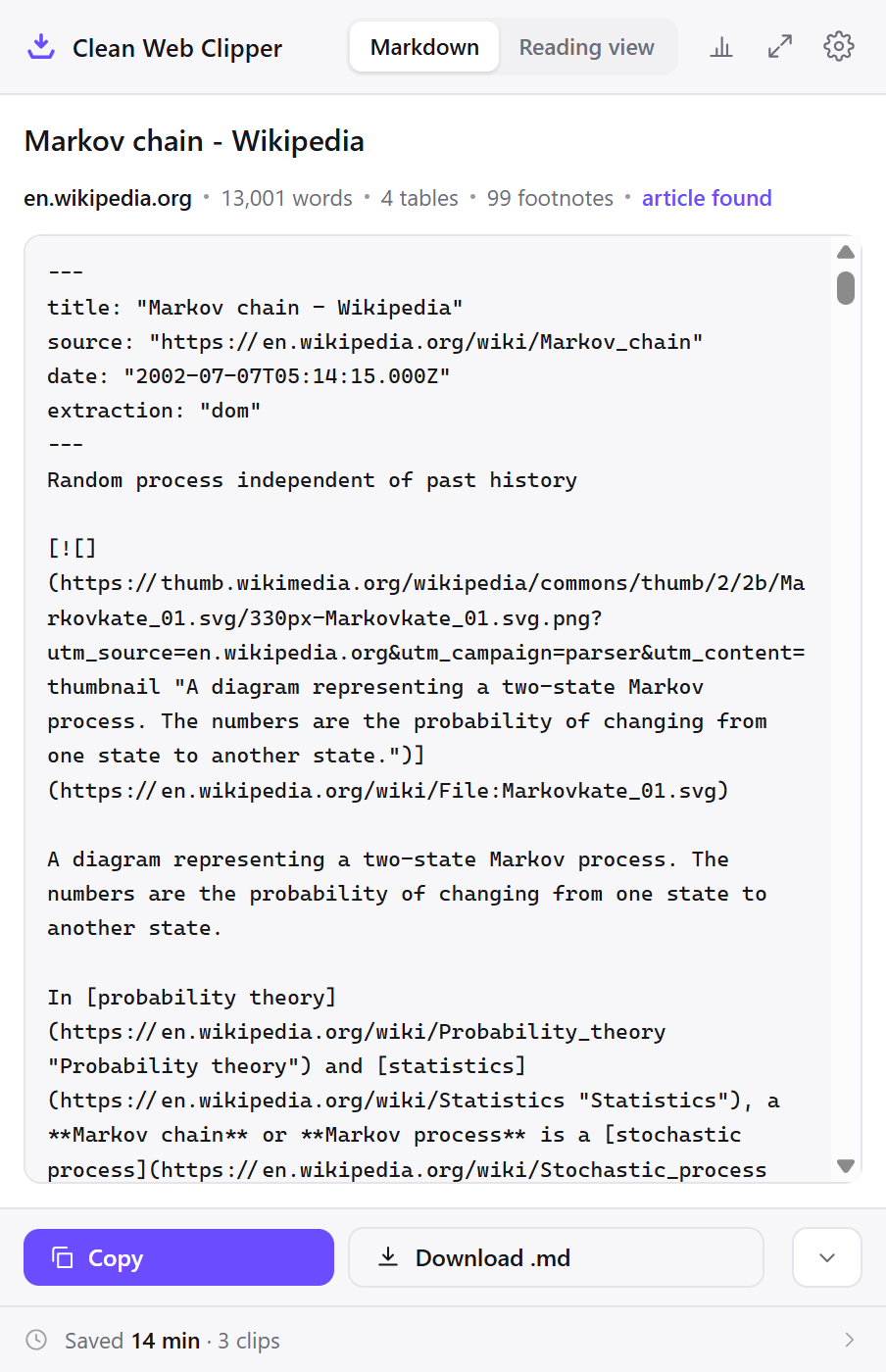
Which leaves the practical problem – capture has to be instant or it does not happen. A story touches forty pages, most of them read at speed and half of them at an hour when nobody is going to open a second tool, paste a URL and wait for a service to respond. A clip takes tens of milliseconds and the measured time is shown in the corner of the window; at that cost you capture everything you read, including the thirty-nine pages that turn out not to matter and the one that does.
What does the record contain?
- Publication date read from the page’s own metadata – JSON-LD,
article:published_time,time[datetime]– not from the running text. - The source URL sits in the frontmatter of every note.
- Full article text without the navigation and promo blocks that change between visits.
- The
extractionfield records how the text was obtained, so the note is auditable months later. - Plain files: no proprietary format, no account, no service that can revoke access to your own material.
- The filename template can carry
{date}– the publication date when the page declared one, the day you clipped when it did not – and the declared date also goes into the frontmatter. - Not one leftover HTML tag across 512 measured pages, so a passage pasted into the CMS does not arrive carrying markup the CMS will then try to render.
- Reddit threads are kept as threads, with each comment’s score, which is the ranking signal a flat copy-paste destroys.
---
title: "Regulator opens inquiry into data-sharing arrangement"
source: "https://apnews.com/article/…"
author: "Staff reporter"
date: "2026-03-04T09:12:00.000Z"
extraction: "dom"
---

The inquiry will examine agreements signed between 2023 and 2025, according to
a notice published on Wednesday.
Set it up for a story
The whole point is that capture costs nothing at the moment you read. Everything below is chosen to remove a decision from that moment and move it into the settings.
- Open Options from the extension icon and point the destination at a folder for the story –
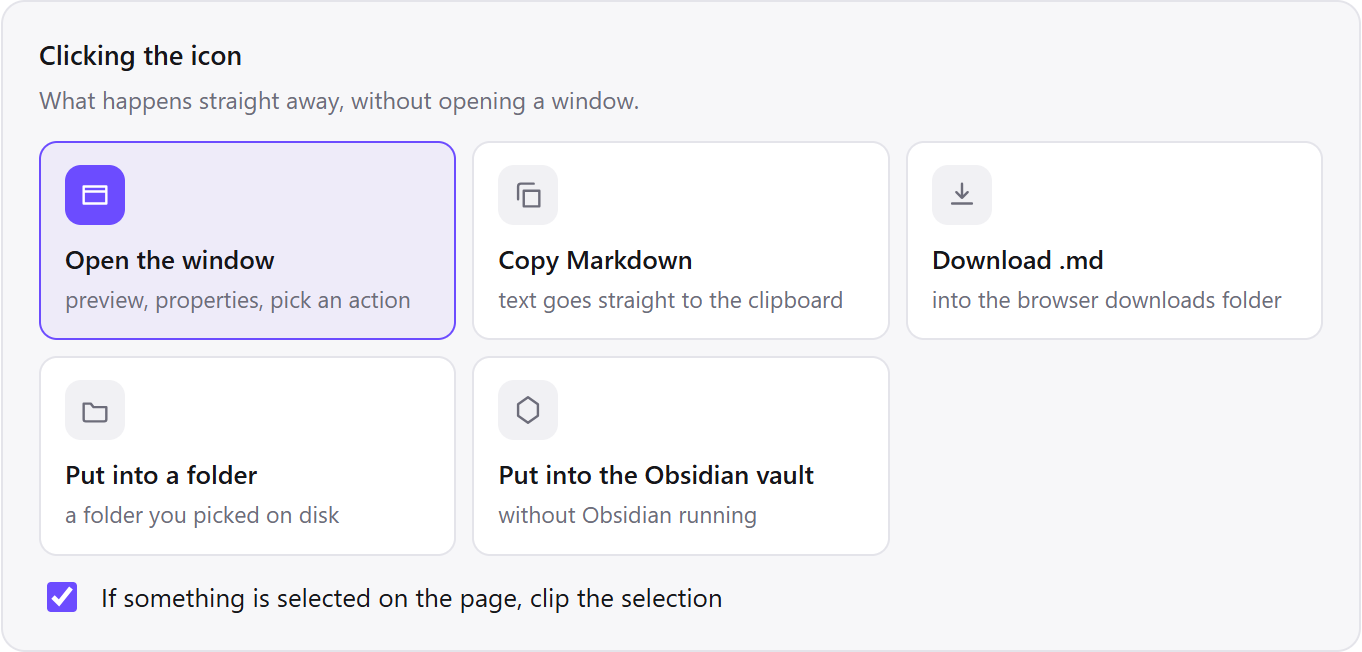
stories/data-sharing/sources. One folder per story, decided once, so nothing has to be filed later. - Set what the icon click does to “save to folder”. Unlike a research workflow, a news workflow should not open a window – the check comes after the capture, because the page may not be there when you get back to it.
- Set the filename template to
{date}-{domain}-{title}. The date (publication date, or clip day where the page declares none) and the outlet are the two things you sort by when a folder holds forty pages from a fortnight. - Turn on all frontmatter fields.
dateis the publication date the page declared;sourceis the exact URL in the address bar, including the query string that may identify a regional variant. - Confirm
Alt+Shift+Mis bound atchrome://extensions/shortcuts. A keystroke gets used at eleven at night; a menu does not. - Add a per-site rule for the discussion sites you work from,
reddit.cominto its own subfolder, so leads and published sources do not sit in the same pile. - Clip a page before you contact anyone about it. A request for comment is the most reliable way to make a page change, and the capture you take afterwards is the wrong one.
Which settings suit capturing at speed?
Every value here trades a little verification at capture time for the certainty of having captured. You can check the file at leisure; you cannot re-read a page that has gone.
| Setting | Value | Why this value here |
|---|---|---|
| Icon click | Save to folder | No window, no dialogue, no decision at the moment the page is still up |
| Destination | One folder per story | Sourcing is per story, and a folder is what an editor or a lawyer can be shown |
| Filename template | {date}-{domain}-{title} | Date and outlet are the two axes you sort forty sources by |
| Frontmatter | All fields on | source keeps the exact URL, including a query string that marks a regional variant |
| Images | Keep as links | The image URL is often the only trace of which photograph was used before it was swapped |
| Per-site rule | reddit.com → subfolder leads | Unverified leads and published sources should not be one pile |
| Shortcut | Alt+Shift+M | Capture that needs a menu is capture that does not happen out of hours |
--- 2026-03-04-regulator-opens-inquiry.md
+++ 2026-03-25-regulator-opens-inquiry.md
@@
-date: "2026-03-04T09:12:00.000Z"
+date: "2026-03-04T09:12:00.000Z"
@@
-The inquiry will examine agreements signed between 2023 and 2025.
+The inquiry will examine agreements signed in 2024.
@@
+Updated 25 March: an earlier version misstated the period under review.
See three captures
Three captures below show what a dated file buys a reporter: a statement that vanished within a day, a wire story whose wording shifted three weeks later, and a forum thread kept as a lead rather than lost as a screenshot. Each depends on the clip existing before anyone had a reason to change the page.
The page that lived for four hours
A company publishes a statement on a Sunday afternoon. You read it, press the shortcut, and the file is in the story folder before you have decided whether it matters. By Monday the page returns a 404 and the public archives never saw it, because nobody submitted the URL while it was up.
What you hold is the text, the address and the date the page declared for itself: not a proof, but a record with enough in it to put the question to the company – this was published at this address, and here is what it said.
Two captures and a diff
You clip a wire story the morning it lands, and again three weeks later when a colleague mentions the framing has shifted. The second file takes a numeric suffix rather than replacing the first, so both are on disk.
A diff between them shows the period under review narrowed from “2023 and 2025” to “2024”, and an update note appended at the foot. Neither change is visible from the URL, and neither would have been recoverable from a bookmark.
A thread as a lead, kept as a thread
A local forum thread names three people who worked at a site during the period you are asking about. You clip it: the nesting comes across as nested blockquotes and each comment keeps its score, so the reply everybody agreed with is still distinguishable from the one nobody did.
It goes into the leads subfolder rather than the story folder, by rule rather than by decision. Six months later that distinction is the difference between sourcing you can point at and material you merely read.
How does it compare to the other ways to keep a page?
The ways of keeping a page below are not alternatives so much as different guarantees. Read the third column carefully. The strongest guarantee is not the one this extension offers.
| How it is done now | What you get | What it costs |
|---|---|---|
| A public archiving service | An independent, timestamped copy anyone can check | Needs the network and the service; some sites block it, and it is a second tool at the moment you are reading |
| Screenshot the page | The layout as it appeared | No searchable text, no URL inside the image, no publication date |
| Print to PDF | A page-shaped copy on your disk | Consent banner included, not diffable, not searchable across a folder |
| Save the page as HTML | A complete local copy with assets | Heavy, awkward to read, and a diff between two captures is unreadable |
| Copy into a notes document | The words, fast | The furniture comes too, and the URL and date do not |
| Clean Web Clipper | Text, address and declared date, in seconds | No layout, no assets, and no third-party timestamp. It is your copy, not proof |
What happens when the capture is not what you expected?
Four causes explain most unexpected captures: a consent dialogue that blocked the article from rendering at all, a live blog or section front refused as mostly link labels, comments cut as page furniture everywhere except Reddit, or a publication date the page itself later rewrote. Each is checkable against what the page actually shows.
Nothing rendered behind the consent dialogue
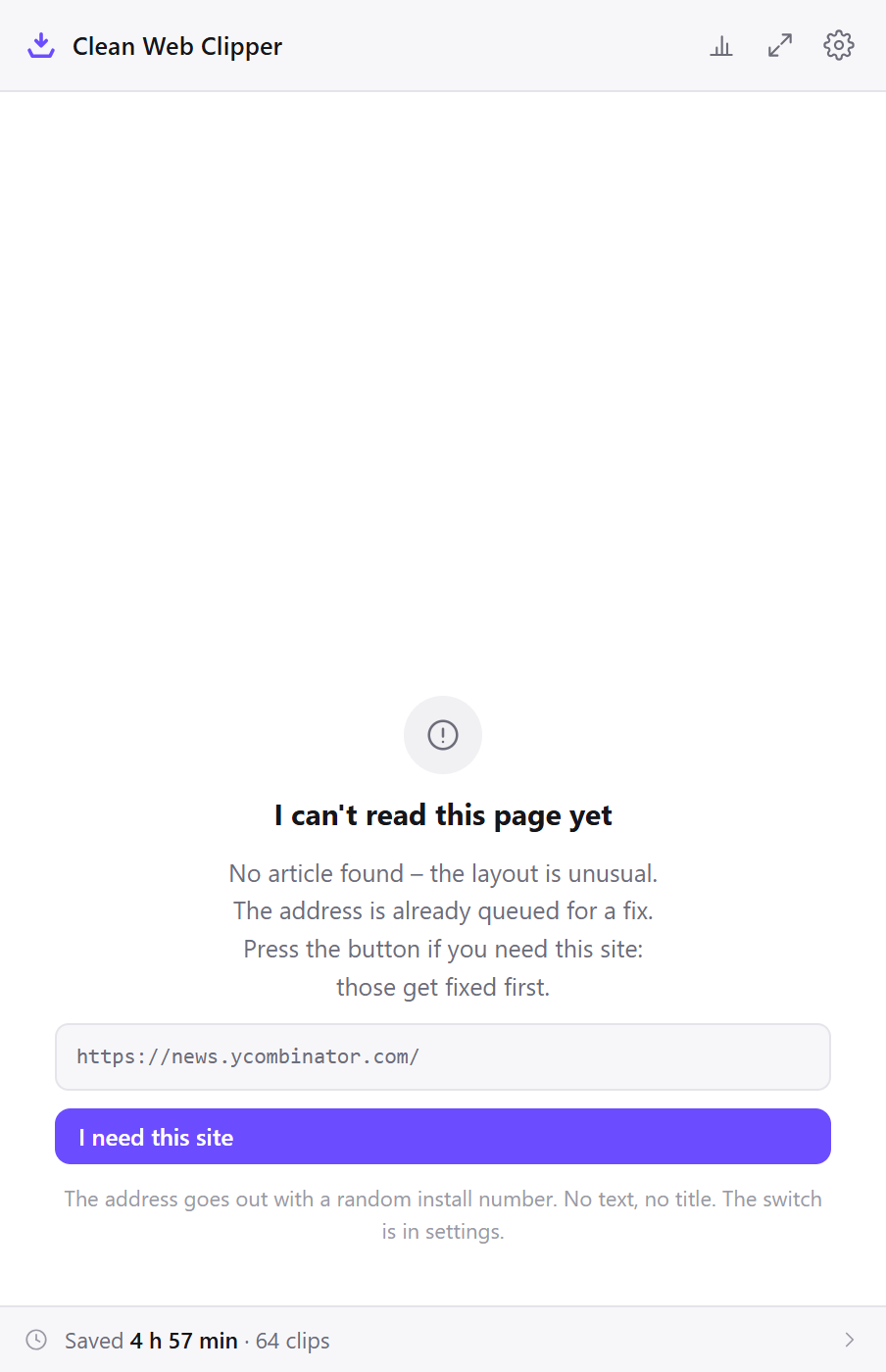
Some sites ship no article at all until consent is answered, so there is nothing in the page for any extension to read and the clip reports “no article”. Answer the dialogue, let the page render, then clip. The consent bar itself is removed from the output either way. This is also why the version you capture is specifically the version served to you, in your region, in that session.
It refuses a live blog or a section front
Both are mostly link labels, and the extension declines any page where more than about a quarter of the extracted characters sit inside links. On a live blog, clip the permalink of the individual entry where the site provides one. On a section front, clip the story rather than the list. The list is the thing that would have arrived as three hundred links.
The comments are missing
Comments are treated as page furniture and cut, with one exception – on Reddit the thread is kept, with each comment’s score. Elsewhere a comment section is indistinguishable from the promotional blocks around it, and keeping it would mean keeping those too. Where a comment matters as a source, quote it separately and note where it was seen.
The publication date is not the date I expected
The field holds the date the page declares in its own markup: JSON-LD datePublished, article:published_time, time[datetime]. A site that rewrites that value when it edits an article will report the newer date, and the extension repeats what the page says rather than second-guessing it. That is one more reason the capture date lives separately, in the filename.
What is this not?
Clean Web Clipper is not a web archive. It saves the text and its metadata, not the page as rendered – no layout, no screenshots, no assets, and no third-party timestamp proving when you captured it. For a visual, independent record use an archiving service; a clip keeps the text on your own disk and answers a different question. Comments are treated as page furniture and cut, except on Reddit, where the thread is kept with each comment’s score.
The page on keeping a personal archive is about that different question.
Is a clip a record or evidence?
Is this a substitute for a web archive? Clean Web Clipper is not a substitute for a web archive: it saves the text, not the page as rendered: no layout, no screenshots, no assets. For a visual record use an archiving service; for the text and its metadata a clip is enough, and it stays on your own disk.
Would a clip stand up as evidence?
Does it capture comments?
Can it record when I clipped it?
{date}, but that is the publication date when the page declared one, and the day you clipped only when it did not. The declared publication date also goes into the frontmatter. If you need the capture day on every file, add it yourself.Does the extension send my clips anywhere?
What about speed, sharing and incognito?
Can I clip a social media post? Sometimes. A feed is refused as “no article” because it is almost entirely link labels. A permalink page for a single post often has enough body text to extract, and on Reddit the thread comes across with its scores. Where a platform renders posts only inside a scrolling feed, there is nothing stable to capture.